
Beyond the Canvas: An Evening with Philip Gray
How Deep Are You Willing to Go for Your Art? I recently attended a live painting exhibition with Philip Gray at Clarendon Fine Art, expecting to enjoy an evening of art and storytelling. What I didn't expect was to leave questioning my own creative practice.

Before the event, I knew Philip Gray as the Irish artist renowned for his dramatic seascapes and landscapes. But hearing him speak and watching him paint live revealed something far more interesting than technical skill alone. What struck me was how deeply adventure is woven into his work.
Philip doesn't simply paint places; he experiences them. A former Navy diver, he has built a career around exploring some of the world's most extraordinary environments in pursuit of inspiration. He spoke about painting underwater, taking his palette beneath the surface and working without brushes, relying instead on what he jokingly described as his most sophisticated piece of equipment: a kitchen sponge. It sounds almost unbelievable, but it perfectly encapsulates his approach to art. The experience comes first, and the painting follows.
His stories ranged from underwater expeditions to creating aerial works from incredible heights. Whether it was diving beneath the ocean's surface or viewing landscapes from above, there was a recurring theme throughout the evening: a willingness to step beyond comfort zones in pursuit of a new perspective.
That philosophy extends beyond his artwork. One aspect of his story that particularly resonated with me was his commitment to charitable causes. Over the years, he has supported numerous organisations, including BBC Children in Need, the Hope Foundation and the Great North Air Ambulance Service. What made this especially meaningful was learning that his connection to the air ambulance charity was personal - his own mother had once been rescued by an air ambulance. It was a reminder that the experiences which shape his paintings also seem to shape the causes he chooses to support.
Watching Philip paint live was mesmerising.
What struck me most wasn't just the speed at which the painting emerged, but the confidence behind every mark. There was no hesitation, no overworking, no second-guessing. Within minutes, a beautiful landscape began to take shape.
As someone who naturally gravitates towards abstract art, I wasn't expecting to feel so inspired by a landscape painter's technique. Yet there was something surprisingly expressive and intuitive about his process. During the demonstration, he used remarkably few tools: a single brush, tissue paper, a palette knife and, for the finest details, his fingers. It was a powerful reminder that creativity isn't about having more tools; it's about knowing how to use what you have.

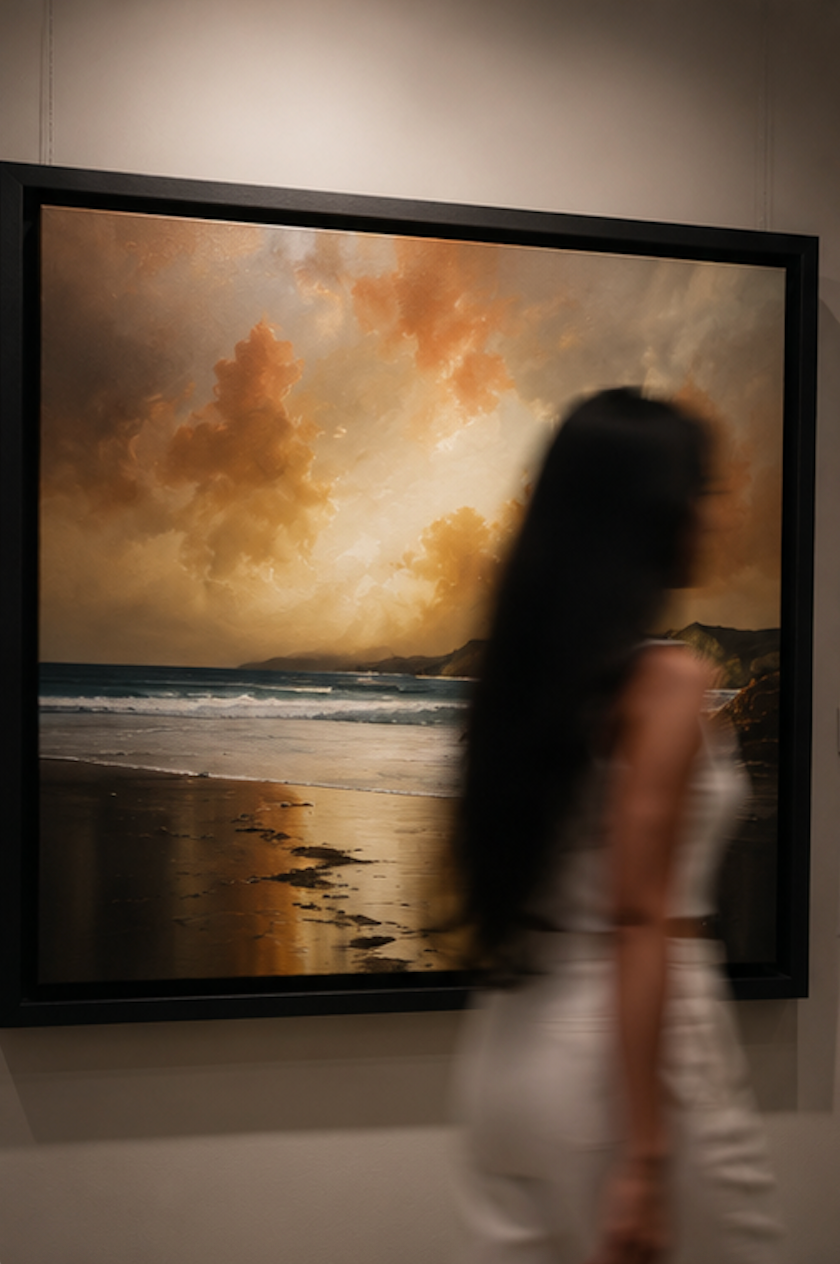
His use of colour was equally captivating. Vibrant blues, turquoise waters and dramatic skies created paintings that felt both realistic and dreamlike. The energy within the work seemed to mirror the adventures that inspired it. One of my favourite discoveries, however, was something much smaller. Hidden throughout many of his paintings were tiny figures - people, dogs, penguins and other subtle characters scattered across vast landscapes. They instantly transported me back to childhood afternoons spent poring over Where's Wally? books. I wasn't searching for anything specific, but I found myself drawn into the paintings, lingering longer as new details revealed themselves.
It reminded me of artists such as Werner Bronkhorst, whose miniature figures bring scale and narrative to expansive scenes. There's something deeply satisfying about artwork that rewards curiosity and continues to reveal itself over time.

But more than anything else, the exhibition left me reflecting on my own relationship with art.
What inspired me wasn't simply Philip's talent or the extraordinary places he has visited. It was the depth of connection he has with his work. His paintings are not just representations of landscapes; they are records of experiences, adventures and moments lived first-hand.
I realised that I had never truly considered how closely art and exploration could be intertwined. For Philip, adventure isn't something separate from the creative process - it is the creative process.
As someone who loves travelling, discovering new places and creating work inspired by different locations, it made me question how I might become more connected to my own practice. How could I merge my love of exploration and art more intentionally? Not necessarily by painting underwater or hanging out of helicopters, but by becoming more immersed in the places, stories and experiences that inspire me.
The evening reminded me that inspiration doesn't always come from the studio. Sometimes it comes from stepping further into the world and allowing those experiences to shape your work in unexpected ways.
Perhaps that's what stayed with me most. Not the paintings themselves, impressive as they were, but the question they left behind:
How deep are you willing to go for your art?


Comments